If there were an award for the most resilient houseplant, the snake plant would win it every time. Also known as mother-in-law's tongue or Sansevieria (recently reclassified as Dracaena), this architectural beauty thrives on neglect, tolerates almost any light condition, and purifies the air while it's at it. It's the perfect plant for beginners, frequent travelers, and anyone who has ever killed a houseplant.
About Snake Plants
Native to West Africa, snake plants are succulent-like plants that store water in their thick, fleshy leaves. In their natural habitat, they endure long dry spells and intense heat — which explains their legendary tolerance for neglect indoors. Their upright, sword-shaped leaves create bold vertical lines that work beautifully in modern and minimalist interiors.
Like aloe vera, snake plants perform a type of photosynthesis called CAM (Crassulacean Acid Metabolism), which means they open their stomata at night to absorb carbon dioxide. This makes them one of the few plants that release oxygen at night, earning them a place in NASA's list of air-purifying plants.
Popular Varieties
- Laurentii: The classic variety with yellow-edged green leaves. Most commonly available and instantly recognizable.
- Zeylanica: Dark green leaves with lighter green mottling. Tougher and even more resilient than Laurentii.
- Hahnii (Bird's Nest): A dwarf variety that forms a low rosette instead of tall swords. Perfect for desks and tabletops.
- Cylindrica: Round, spear-like leaves that can be braided. A dramatic, sculptural statement plant.
- Moonshine: Silvery-gray-green leaves with a ghostly, elegant appearance. A collector's favorite.
Light Requirements
Snake plants are incredibly adaptable when it comes to light. They prefer bright, indirect light but will tolerate low light conditions that would kill most other plants. The main difference: plants in brighter light grow faster, produce more pups, and maintain their vibrant coloration. In very low light, growth slows to almost nothing, and variegated varieties may lose their patterning.
Pro Tip
Variegated snake plants (like Laurentii) need more light than solid green varieties (like Zeylanica). If your Laurentii is losing its yellow edges and turning all green, it needs more light. This is the plant reverting to its more vigorous all-green form.
Watering
The number one rule: when in doubt, don't water. Overwatering is virtually the only way to kill a snake plant. Their succulent leaves store water, allowing them to go weeks without a drink.
Water only when the soil is completely dry throughout the pot. In practice, this means every 2-3 weeks in summer and every 4-6 weeks in winter. When you do water, give it a thorough soak and let it drain completely. Never let the plant sit in water.
Signs of Watering Issues
- Overwatered: Leaves become mushy and smelly at the base, yellowing, soil stays wet — this is root rot and is usually fatal if not caught early
- Underwatered: Leaves develop dry, wrinkled, or slightly shriveled appearance — the plant recovers quickly when watered
Soil and Potting
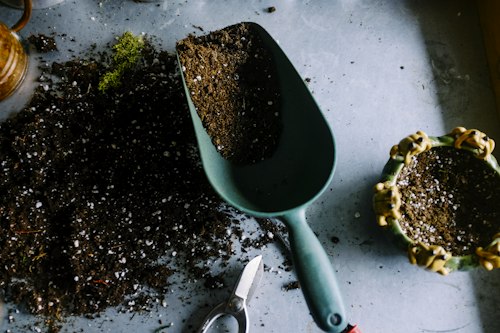
Use a well-draining soil mix — regular cactus/succulent pot works well, or mix standard potting soil with 30-50% perlite or coarse sand. The pot must have drainage holes; this is non-negotiable.
Snake plants actually prefer being root-bound and bloom more readily when pot-bound. Repot only when the plant is literally cracking its pot or pushing itself out. When repotting, go up only one size and don't bury the plant deeper than it was before — the base of the leaves should sit just above the soil line.
Common Mistake
Don't use too large a pot. Snake plants in oversized pots are far more likely to suffer from root rot because the excess soil retains moisture for too long. A pot that seems slightly too small is actually perfect.
Temperature and Humidity
Snake plants are comfortable in the same temperature range as people: 60-85°F (15-29°C). They can tolerate brief dips to 50°F (10°C) but will be damaged by frost. They're completely indifferent to humidity levels, making them ideal for dry homes and offices.
Keep them away from cold drafts, air conditioners, and exterior doors in winter. Sudden cold can cause permanent leaf damage.
Fertilizing
Snake plants need very little fertilizer. Feed once in spring and once in summer with a diluted balanced fertilizer (half strength). That's it. Over-fertilizing causes brown tips and salt buildup. Skip feeding entirely if the plant is in low light.
Propagation
Snake plants are easy to propagate through several methods:
- Division: The easiest method. When repotting, separate the clumps of leaves at the roots, ensuring each division has roots attached. Pot each division separately.
- Leaf cuttings in water: Cut a healthy leaf into 3-4 inch sections, noting which end was closest to the roots. Place the bottom end in water and wait for roots to develop (3-5 weeks), then pot in soil.
- Leaf cuttings in soil: Let leaf sections callus for 1-2 days, then insert the bottom end into moist succulent soil. Keep barely moist until roots develop.
Note on Variegation
Leaf cuttings from variegated snake plants (like Laurentii) will grow back as solid green. If you want to preserve the yellow variegation, you must propagate by division, not leaf cuttings.
Common Problems
Root Rot / Mushy Base
Caused by overwatering. If caught early, remove the plant from its pot, cut away all mushy roots and leaves with a clean knife, let the cuts dry for a day, and repot in fresh, dry soil. Reduce watering frequency.
Brown Tips
Usually caused by cold damage, over-fertilizing, or fluoride in tap water. Trim with scissors following the natural leaf shape, and switch to filtered water.
Bent or Flopping Leaves
Snake plant leaves should stand upright. Flopping is usually caused by overwatering (the leaves become waterlogged and heavy) or insufficient light (the plant stretches and weakens). Correct the watering and light conditions; new growth will be sturdy.
"The snake plant is proof that beauty and resilience are not opposites. It stands tall through drought, dim light, and decades of neglect — asking nothing, offering everything, and quietly making the air cleaner while it does."